Ozone slurry ice combines cooling, sterilization and deodorization in one pumpable ice. Learn how it extends seafood shelf life by 3–6 days and meets FSMA export standards.
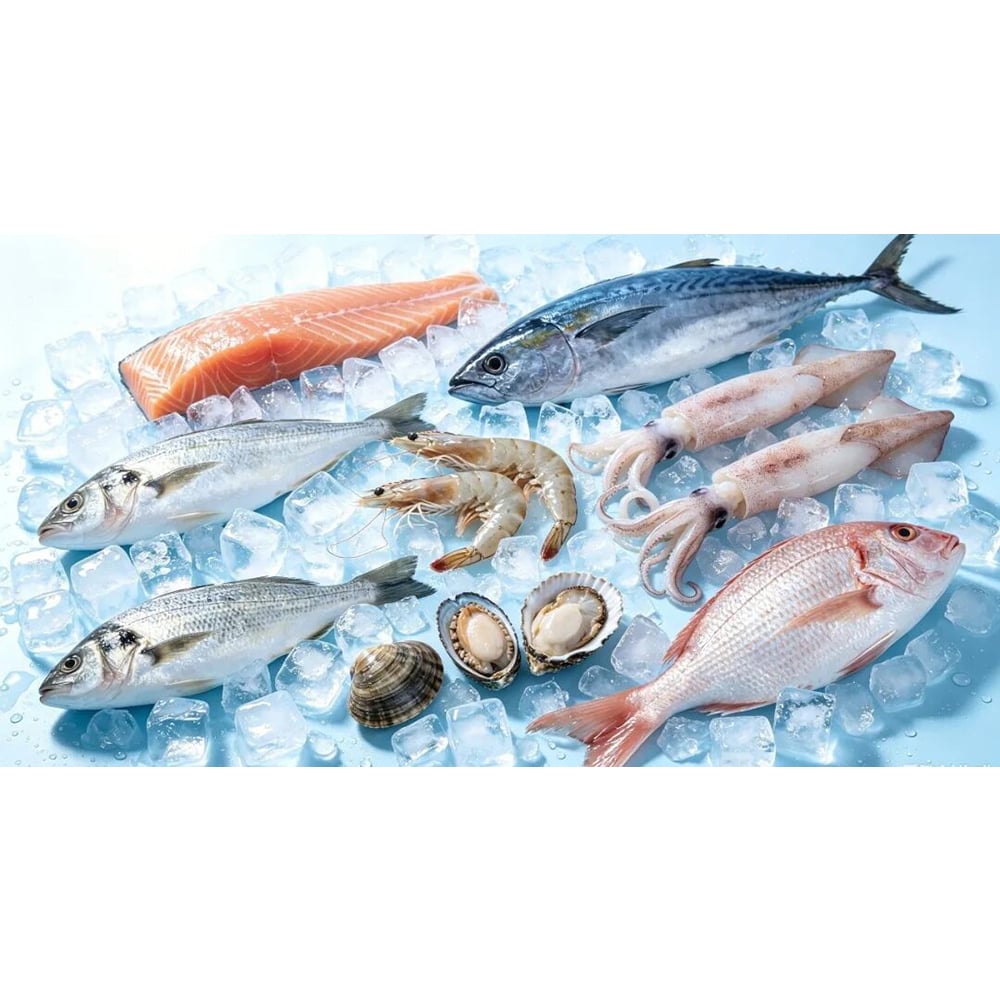
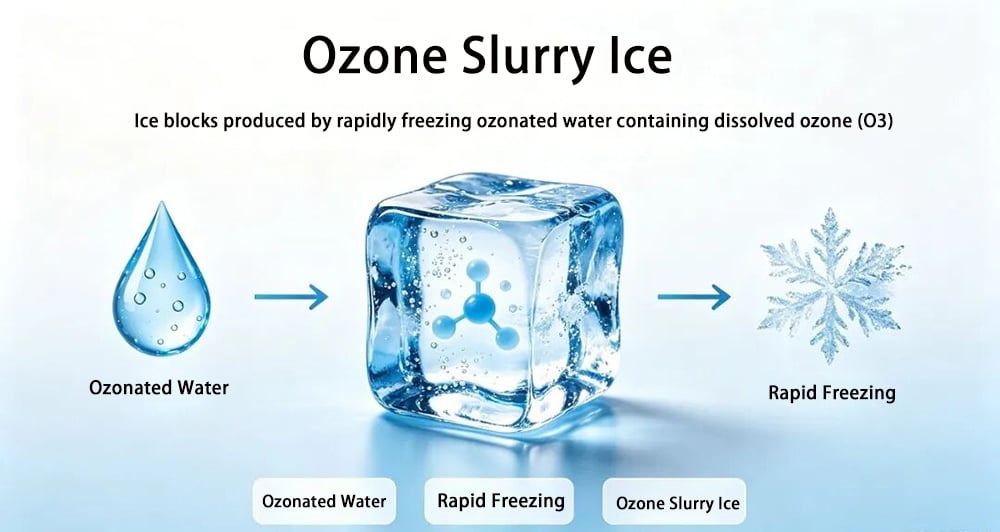
Ozone slurry ice is a flowable ice-water mixture made by rapidly freezing ozone-dissolved water. Unlike solid block ice or flake ice, it stays pumpable, with ozone molecules locked inside both the ice crystals and the liquid water. As it melts slowly at low temperature, ozone is released gradually — cooling the fish, killing bacteria and removing fishy odors at the same time, with zero chemical residue.
For fishing fleets and seafood processors, this means one replacement for three separate processes: pre-cooling, disinfection and deodorization.
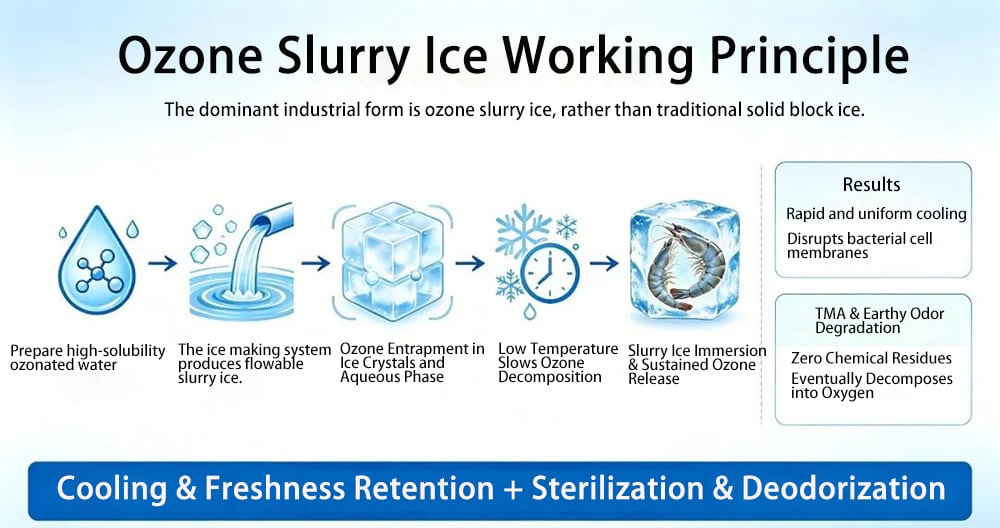
Ordinary ozonated water decomposes quickly at room temperature, so its active window is short. When ozone is integrated into slurry ice, the low temperature dramatically slows decomposition. During immersion storage, ozone is released steadily and performs three jobs at once:
The result is simultaneous temperature lock-in, microbial control and odor removal — all without additives.
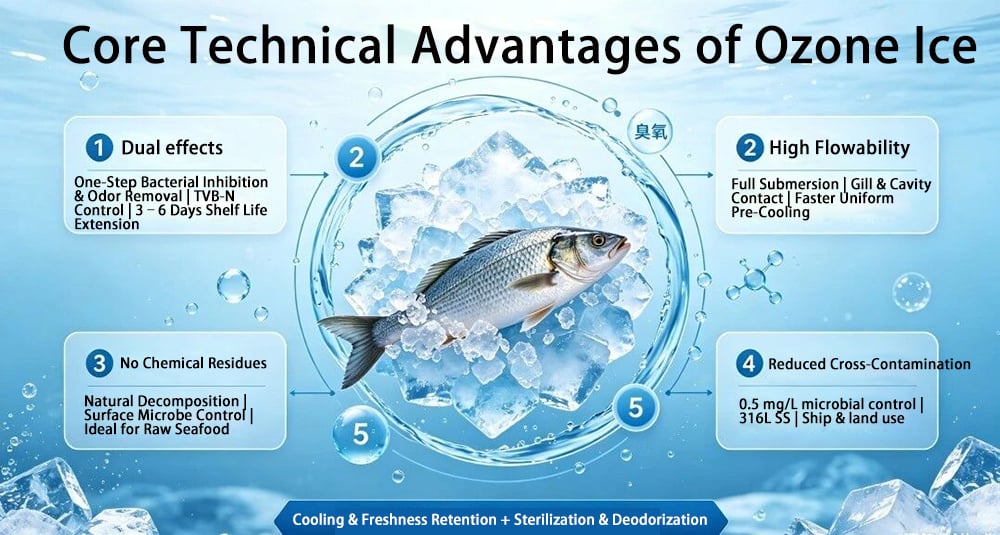
While conventional ice only lowers temperature, ozone slurry ice keeps releasing ozone throughout cold storage. It suppresses psychrotrophic spoilage bacteria, Vibrio and Listeria while oxidizing odor-causing amines and slowing fat oxidation. Total Volatile Basic Nitrogen (TVB-N) buildup is delayed, and shelf life is extended by 3–6 days compared with standard flake ice.
Because slurry ice is pumpable, it fully submerges fish carcasses and reaches every gap, gill cavity and abdominal cavity. No cold spots, no uneven stacking. On board a fishing vessel, it can be pumped immediately after catch, delivering instant pre-cooling at sea — the single biggest lever on final freshness grade.
Ozone breaks down completely into oxygen. There is no residual disinfectant on the fish or in processing water, which makes the technology fully compatible with strict international export requirements and organic seafood certification. Buyers in the EU, US and Japan face no chemical-residue rejection risk.
After gutting and evisceration, ozone slurry ice continuously suppresses microbes in the pre-cooling water and on equipment surfaces. This reduces batch-to-batch cross-contamination and lowers the risk of foodborne pathogens — especially valuable for raw-consumption products such as shellfish and sashimi-grade salmon.
Ozone concentration can be matched to each species. Industrial operations typically run a conservative 0.2–0.5 mg/L range to avoid protein oxidation and whitening of fish flesh. Wetted parts use 316L stainless steel for ozone corrosion resistance, suitable both for shipboard installation and land-based processing plants.
Ozone slurry ice is a mature, mainstream technology in Northern European seafood exports. Icelandic manufacturer KAPP Skaginn integrates ozone units into shipboard slurry ice systems deployed across a large North Atlantic fleet. Cod, haddock and plaice go directly into ozone slurry ice on catch. On 8–12 day offshore trips, product holds ice-fresh quality, supporting higher export grades and market pricing.
Leading firms including Trident Seafoods use ozone slurry ice on board vessels to preserve wild Pacific salmon in Alaskan fisheries. Field data shows that after 8–9 days of storage, the total bacterial count in salmon held in ozone ice was only 3% of the count in conventional flake-ice samples — protecting sashimi-grade supply chains.
In Maine and Gulf of Mexico shellfish plants, a combined ozone ice + ozonated water process controls Vibrio parahaemolyticus in oysters and mussels, helping plants meet the U.S. Food Safety Modernization Act (FSMA) shellfish safety requirements.
Most Asia-Pacific fleets still use conventional flake ice, but adoption of ozone slurry ice is growing steadily. Tier-one seafood producers in the region now use it for pre-cooling and deodorization of salmon, prawns and poultry, mainly to serve export orders and high-end raw-seafood customers. It is typically applied at catch landing and post-slaughter pre-cooling, and can be combined with conventional flake ice for long-haul cold-chain transport.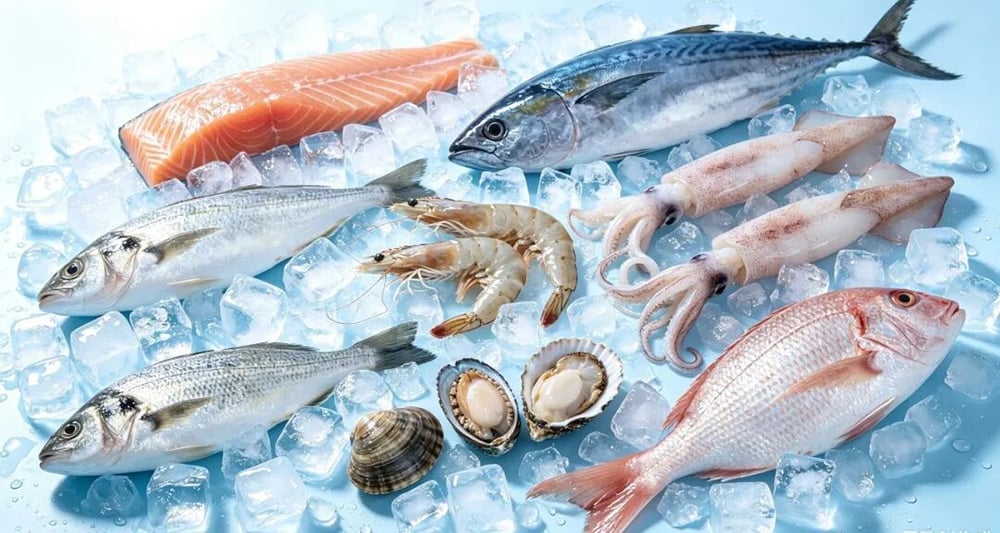
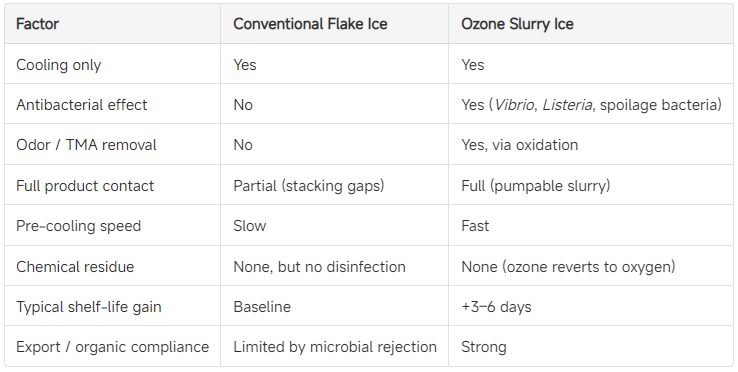
Ozone Slurry Ice vs. Conventional Flake Ice
Is ozone slurry ice safe for sashimi-grade seafood? Yes. Ozone decomposes into pure oxygen with no residual disinfectant on the product. At the standard 0.2–0.5 mg/L concentration used in industrial operations, protein oxidation and off-whitening are avoided while pathogen levels are suppressed.
How much longer can seafood stay fresh with ozone slurry ice? Field data from wild salmon operations shows an extension of approximately 3–6 days compared with conventional flake ice, depending on species and storage temperature.
Can it be used on existing fishing vessels? Yes. Shipboard slurry ice systems with integrated ozone units are available as retrofits. Wetted components are built in 316L stainless steel for ozone corrosion resistance.
Does ozone slurry ice replace flake ice entirely? Not necessarily. Many operations use ozone slurry ice for immediate pre-cooling at catch, then switch to conventional flake ice for long-haul cold-chain transport. The two are complementary.
Is it approved under FSMA and EU food safety rules? Ozone is recognized as an antimicrobial processing aid by the U.S. FDA under FSMA. It is also accepted under EU regulations as a processing aid with no residual limit, because it decomposes to oxygen. Always verify current regulatory status for your destination market.
The global seafood industry is moving from a "cooling-only" model toward integrated low-temperature preservation with built-in antimicrobial and deodorizing functions. After decades of proven use on fishing fleets and processing plants worldwide, ozone slurry ice gives seafood processors a clear path to higher product quality, lower post-harvest loss and access to high-value export markets.
Still relying on traditional flake ice? Talk to our engineering team about a customized ozone slurry ice solution for your vessel or processing plant — designed for your species, your catch volume and your destination market's compliance requirements.
 EN
EN